
 Back to all articles
Protect, Lead, Coach, Support: 4 Steps of Digital Guardianship
11 March 2026

When our tamariki head online it can feel like they’re stepping into a world we don’t always understand. Technology changes quickly, new apps appear overnight, and trends come and go. Before we know it, our tamariki are playing games, joining group chats, scrolling through feeds, and sometimes we’re left wondering what’s really happening in that space, and how we can keep up.

Stepping into the space
When children are small, the space between us and them is close; we sit beside them as they play, we hold their hand as they cross the street, and we set the rules to keep them safe in the big wide world. As they grow, it can feel as though that space widens as they explore more on their own, build their own friendships, discover and develop their own interests and start to become more independent in everyday life.
The same parallel could be made when thinking about the digital space. When tamariki are young we choose what is appropriate for them to watch online, we control access to the devices and often put controls and settings in place to keep them safer. As they grow, they start to explore online spaces on their own, maybe discovering gaming, using search engines for homework, or joining group chats with friends.
As that digital space evolves and changes, the more intentional we need to be in keeping the relationship strong.
Learning that flows both ways
When tamariki are little they learn by copying us (repeating our words, following routines, soaking up the values we live by). But as they grow something powerful happens: they begin to teach us. They know how the latest app works, what’s trending, and how to move in their online worlds – and they seem to know this intuitively and instinctively, as true digital natives.
By being interested and curious we can step into the digital space to learn together. As parents, caregivers and whānau we bring wisdom, values, and life experience; and our tamariki bring digital knowledge, creativity, and fresh perspectives. Creating the opportunities for learning to flow in both directions can be a powerful way to navigate digital spaces together, with whanaungatanga (connection), manaakitanga (care) and whakaute (respect).
How to connect across the digital space
- Be curious, not expert
- You don’t need to know everything. Ask your child to show you what they love online
- Share your values
- Talk about what respect, kindness, or courage look like in digital spaces
- Make it a two-way street
- Let them be the teacher sometimes the add your perspective in return
- Keep the door open
- The wider the space feels, the more important it is that your child feels safe coming back to you if something happens
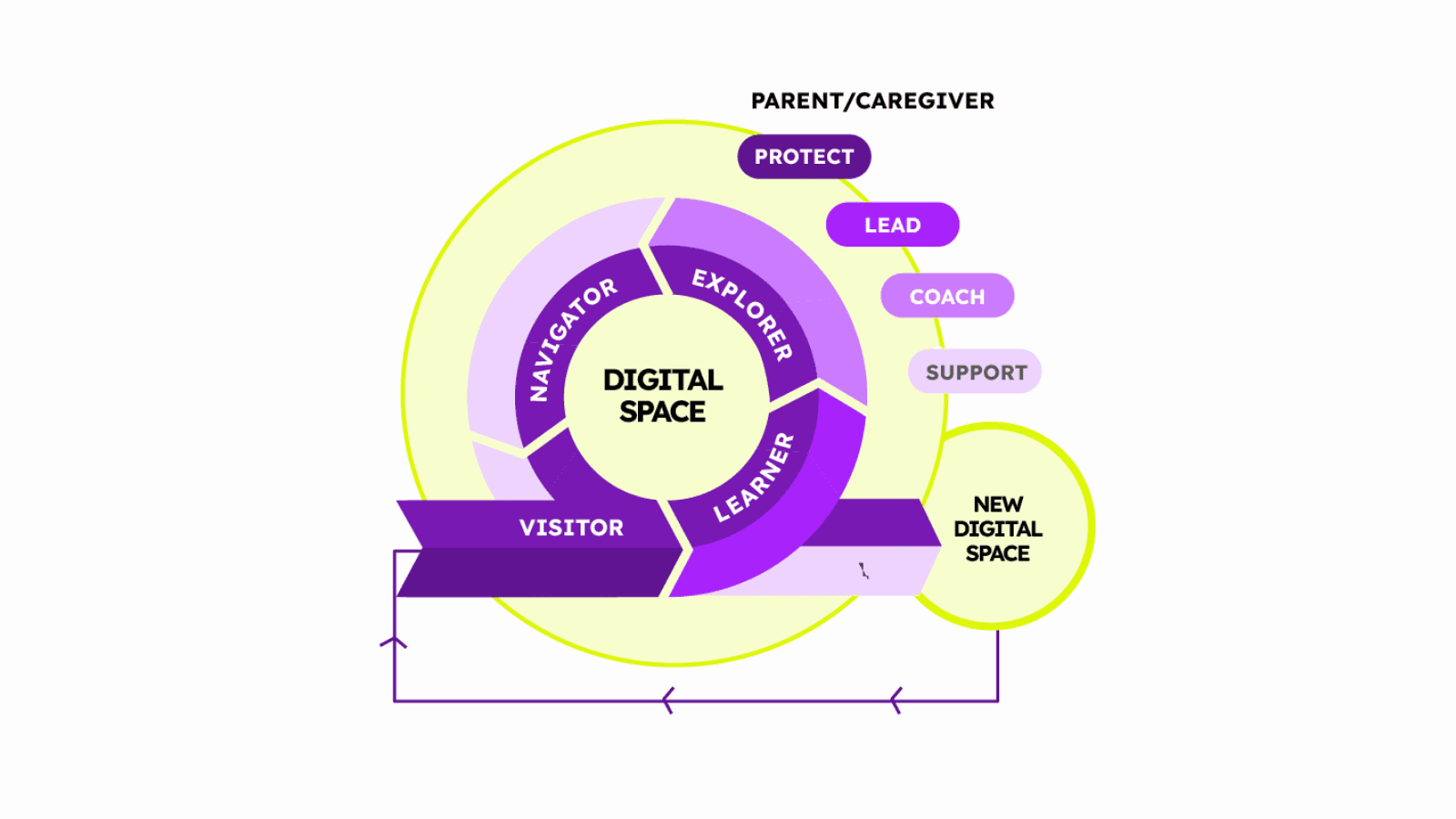
Supporting your child as they grow up online can be viewed in four interconnected phases - moving back and forth as new online spaces and experiences open up.
Four phases of kaitiakitanga
When tamariki are very young, we are right there to protect and shield them, guiding every step and interaction. As they develop skills, confidence, and independence, their online spaces expands and they want to be more autonomous – and so staying connected in and across those spaces becomes more important as they begin to learn, explore, and navigate digital environments.
Think of it as four phases of a cycle, from protection to empowerment. These stages aren’t strict rules, but a way to understand how your role shifts over time, and how you can support your child’s safe and positive online experiences at every step.
Perhaps the most comforting part of this model is that it allows for movement in both directions. Even confident teenagers sometimes need guidance when something new appears - a new platform, a difficult online experience, a moment where judgement slips. In those moments, it’s perfectly natural for parents or caregivers to step back into earlier roles — protecting more closely or coaching through a challenge.
Digital parenting isn’t a ladder you climb once. It’s more like a rhythm you move through again and again as your child grows and the digital world changes around you.
What it looks like
When children need protection
In the early years of digital life, children are just beginning to interact with online spaces and devices. They might be watching videos, playing simple games in a preschool app, or connecting with family through video calls.
At this stage, parents are usually very close to the experience, choosing content, sitting beside their child, and setting up safety settings to support safe exploration.
It’s a phase of protection, but it’s also a time when something important begins: the conversations that shape how children think about technology.
When parents ask questions, show curiosity, and talk about kindness or safety online, children begin to build the habits that will support them later.
When children begin to learn for themselves
As children grow, their confidence with technology grows too. They want to choose what they watch. They want to try new games. They want to explore. Here, the guardian role shifts slightly, from protecting every step to leading by example.
Tamariki start learning not just from rules, but from watching how adults use technology themselves. They notice whether we put our phones down during dinner. They hear how we talk about people online. They see how we respond to mistakes or misunderstandings.
At this stage, many families begin involving children in conversations about digital habits and agreeing together on expectations and boundaries. The goal is no longer simply control - it’s helping children understand and internalise good habits.
When independence grows
As children move toward the tween and early teenage years, their online lives often become more social. They might join group chats, follow influencers, explore new communities, or express themselves creatively online. This is when digital guardianship often shifts into coaching.
Instead of directing every decision, you start helping young people think things through. You might ask them questions to help them reflect on their choices and actions (What do you like about this platform? How do you decide who to follow? What would you do if someone said something unkind online?)
Young people often understand the technology itself very well, but what they still need is help applying judgement, empathy, and perspective in complex online situations. That’s where parents, caregivers, whānau and older siblings remain incredibly important.
When young people begin shaping their own digital world
Eventually many rangatahi become confident digital citizens. They may be creating content, collaborating with others, or exploring ideas and communities that matter to them. At this stage, the digital guardian role often becomes one of support and partnership.
You’re no longer directing every decision. Instead, you’re a trusted sounding board and someone they can talk to when something feels complicated, confusing, or overwhelming.
Your presence still matters deeply. Not because you control their digital life, but because they know they can come to you when it matters.
Connection is the constant
Technology will keep changing and that’s the one thing we can be certain of. But the most important part of being a digital guardian doesn’t change.
Across every phase and stage - protecting, leading, coaching, or supporting - what matters most is the connection between you and your child.
Staying curious about their online world.
Listening without judgement.
Keeping conversations open, even when the topics feel uncomfortable.
Because when children know they can talk to you about what happens online, they carry something with them that no safety setting can replace. They carry a trusted guardian, and that may be the most powerful digital safety tool of all.
A final thought
Supporting your child’s online safety in the digital age isn’t about being a tech expert or knowing all about the latest app.
The digital space between you and your child is not a gap to fear, it’s a space to nurture. As it evolves, the opportunities to learn together and from each other grow, and so arguably what matters most is protecting the relationship, keeping connection alive, and walking alongside your tamariki as they learn, explore, and navigate online.